

The Commodity Futures Trading Commission has told two federally registered prediction market exchanges, Novig and ProphetX, to hold off on launching sports event contracts they had already self-certified. The letters were first reported by Front Office Sports, and a CFTC spokesperson confirmed they were sent.
The move is one of the clearest signals yet that the federal regulator will not simply wave through every sports market an exchange wants to list. It targets two narrow product types: “micro” contracts on in-game moments and so-called scorigami contracts on final scores that have never occurred before.
What the CFTC told the two exchanges
According to Front Office Sports’ October 22 report, which cited multiple sources, the agency’s letters accused both companies of making false self-certifications. In plain terms, the CFTC believes the planned contracts may not be permitted under the Commodity Exchange Act, the federal law that governs futures and options trading.
The agency raised a different concern with each company:
- Novig: The CFTC said the micro contracts it certified, such as a market on which player scores first in a basketball game, are vulnerable to manipulation.
- ProphetX: The agency said its scorigami contracts, which turn on whether a game ends with a final score never before recorded in that sport, do not fit the definition of a swap under the act.
Neither set of contracts had gone live, so no customers were trading them. Both exchanges will be able to explain to the regulator why the markets should be allowed.
A CFTC spokesperson confirmed the letters in a statement. “Any derivatives contract offered by a CFTC-regulated exchange must be compliant with the Commodity Exchange Act,” the spokesperson said, adding that “the CFTC’s rejection of ‘micro trades’ today reflect a broader commitment from Chairman [Michael] Selig and the CFTC to protect consumers from potential fraud or manipulation.”
Any derivatives contract offered by a CFTC-regulated exchange must be compliant with the Commodity Exchange Act.
CFTC spokesperson
One person familiar with the matter described the letters to Front Office Sports as “kind of a warning shot” for the prediction market industry.
How self-certification works
Exchanges registered with the CFTC, including Novig and ProphetX, do not need the agency’s approval before they list a new contract. They can certify on their own that a product complies with federal law and put it up for trading, while the CFTC keeps the power to step in afterward.
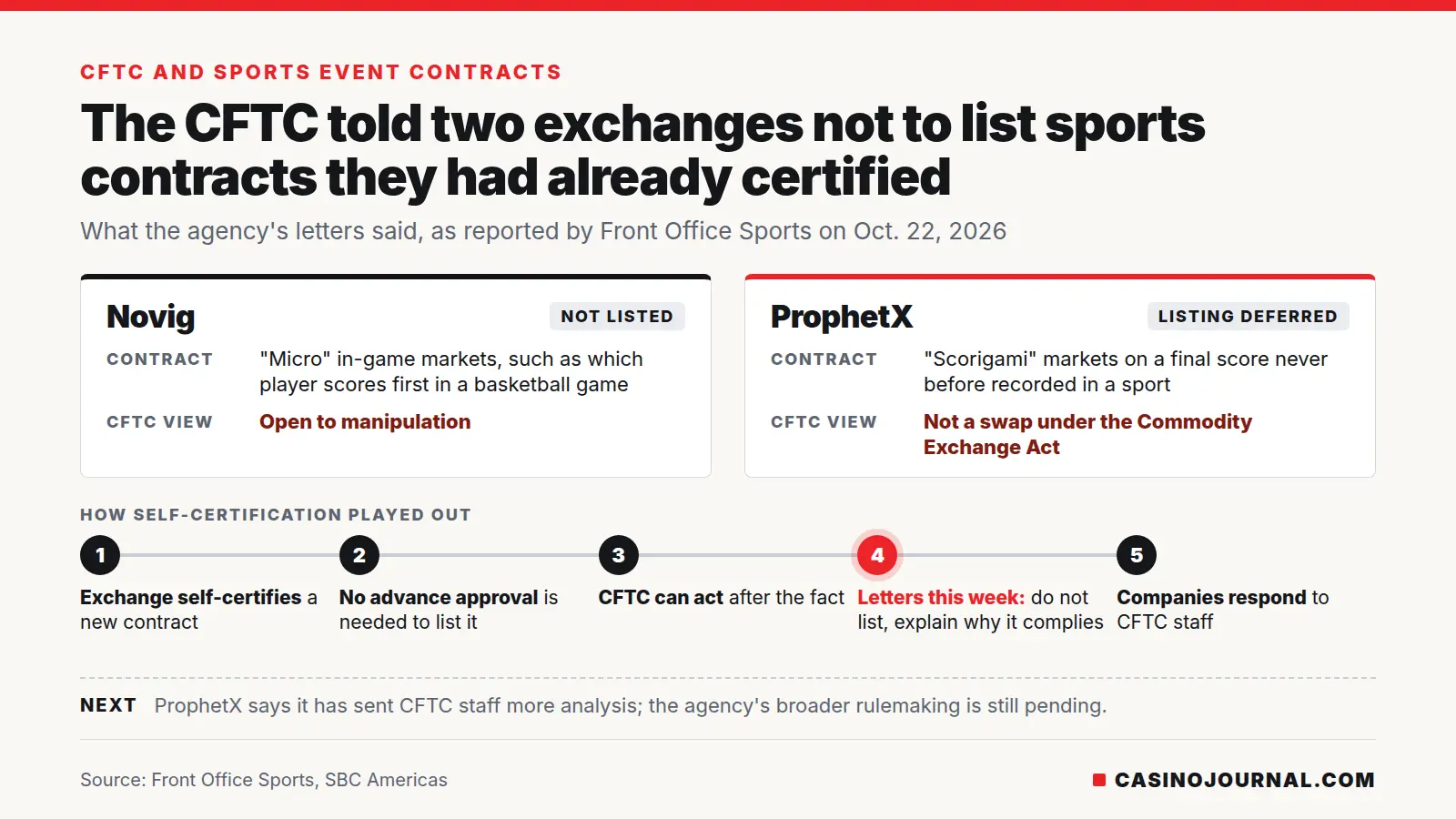
That is why this week’s action stands out. The agency moved before the products launched, and it declined to say whether this is the first time it has told an exchange to hold back a sports contract that had already been self-certified.
It is also unclear what the CFTC would do if either company ignored the request. The letters tell Novig and ProphetX not to list the contracts for now, and Front Office Sports said the consequences of refusing remain an open question.
What the companies said
ProphetX confirmed that agency staff had contacted it but described the request as softer than an order. According to a company spokesperson, staff “requested that we voluntarily defer listing the Scorigami contracts pending further review, not that we withdraw them.”
“We complied with that request and have since provided additional analysis supporting the contracts’ regulatory compliance and economic utility,” the spokesperson added. “We remain constructively engaged with staff.” Novig did not immediately respond to Front Office Sports’ request for comment.
We complied with that request and have since provided additional analysis supporting the contracts’ regulatory compliance and economic utility.
ProphetX spokesperson
Not every operator agrees with the CFTC’s stance. Sources told Front Office Sports that other exchanges have voiced frustration to the agency, noting that many state gambling regulators allow the same kinds of wagers on licensed sportsbooks.
A broader cleanup under Selig
The letters are part of what sources described to Front Office Sports as a “broader cleanup” that Selig is pursuing before the agency finalizes its prediction market rules. Last month, the outlet reported, the CFTC asked several platforms, including Kalshi, Polymarket, Rothera and Novig, for details on their incentive programs amid worries that some promotions could mislead traders.
Senior CFTC officials have also held talks with companies including DraftKings and FanDuel and warned them that listing micro contracts could bring similar action, the same sources said. One source said the Novig and ProphetX markets are the kinds of contracts that professional leagues have given the “most negative feedback” about.
Oversight is not limited to new listings. TokenPost reported that the CFTC said on October 23 that it is monitoring prediction markets for possible manipulation.
Why micro markets are a flashpoint
The CFTC’s 267-page notice of proposed rulemaking, issued in June, would restrict in-game prop markets, such as contracts on the next pitch, and would limit markets on high school sports. As SBC Americas noted, the proposal flags integrity and manipulation concerns and questions whether some in-game markets serve the public interest or satisfy the act.
The same debate is playing out in state-regulated betting. The NBA moved this month to narrow what its partner sportsbooks may sell, pulling certain player prop and micro markets, among them bets on which player sinks the opening basket. Those limits apply only to traditional sportsbooks, not prediction markets, which the league has not formally embraced.
Where the states fit in
The federal pushback comes during a busy stretch of state action against prediction markets. In the past week, Novig and Crypto.com each sued Missouri, Polymarket sued Ohio, Utah sued Kalshi, and Michigan’s attorney general alleged that Kalshi violated a preliminary injunction by advertising in the state, SBC Americas reported.
Ohio has also turned its attention to the businesses that support prediction markets. The Ohio Casino Control Commission put that warning in writing on Tuesday, October 20. Its letter, which The Event Horizon obtained and reported first, went to every company that holds or is seeking an Ohio sports wagering or fantasy license and said that backing unlicensed sports event contract operators “raises significant suitability concerns.” The letter reaches a wide range of companies:
- Licensed sportsbook and fantasy contest operators.
- Service providers such as market makers, integrity monitors including IC360, and data firms.
- All recipients were told to stop any such activity and respond by October 30.
Polymarket’s federal complaint against Ohio, filed October 16, argues that the state’s enforcement threats violate the Commerce Clause and are preempted by the Commodity Exchange Act.
What happens next
Novig and ProphetX can now make their case to CFTC staff, and ProphetX says it has already sent additional analysis. The agency’s final prediction market rules, still pending, will largely determine whether micro and novelty sports contracts have a place on federally regulated exchanges. For now, the letters suggest the CFTC intends to police the edges of sports event contracts itself, even as states press their own cases against the industry in court.
21+ (18+ in some states). Gambling problem? Call 1-800-GAMBLER.
Sources
- Novig, ProphetX Told to Pause Scorigami, Micro Contract Plans, Front Office Sports, October 22, 2026
- Prediction Markets Weekly: Yes, there is news outside of court, SBC Americas, October 23, 2026
- Ohio Escalates Prediction Markets Fight With New Warning To Gaming Licensees, The Event Horizon, October 21, 2026
- CFTC Says It Is Watching Prediction Markets for Manipulation, TokenPost, October 24, 2026
Michael Johnson is a senior copywriter and content strategist who has written for regulated gambling operators for close to a decade. He was a copywriter at The Rank Group in Gibraltar (2017-2019), a senior copywriter in the Ladbrokes Coral creative studio at Entain (2019-2021) and senior creative copywriter at Eyas Gaming (2021-2024), where he led messaging for gaming brands in regulated international markets and worked closely with compliance teams. Before that he wrote about videogames and esports for PC Gamer, Rock Paper Shotgun, Red Bull Esports and Kotaku UK. At Casinojournal he covers US gambling regulation, prediction markets, sports betting and sweepstakes casinos.
LinkedInMore news
- Federal Judge Bars Kalshi Sports Contracts on Two California Tribes’ Lands After Ninth Circuit Reversal
- Arkansas Sues Kalshi and Sweepstakes Operator VGW, Accusing Both of Running Illegal Gambling
- CFTC Gives Prediction Markets 30 Days to Stop Blocking States, Setting Up a Clash With Courts
- DraftKings, FanDuel, Fanatics and Robinhood Pull Sports Contracts From Utah After Kalshi Charges